Search

Biology Park

Category

Book review

Exit West – A review

Last week, the Booker prize short-list was released. I am one of those people who loves to immediately find the short-listed titles in my local library and read them. Among the authors the only one I recognized was Mohsin Hamid. I had read his previously Booker prize nominated novel “The Reluctant Fundamentalist” and was happy to find that his latest book “Exit West” was also readily available to read at my library.

Exit West is a story of two people Saeed and Nadia and what it means to be a refugee, uprooted from what is familiar to places that are unwelcoming. Saeed and Nadia are from a nameless country that finds itself taken over piece by piece by militants. It could very well be any one of the conflict-ridden countries of the world. Saeed is from a loving tight knit family and Nadia is an independent woman who is estranged from her family but manages to make a life of her own in a country we are told, such a thing was not easy or common. They take a class together and slowly start going out and their story unfolds. But so does the war. As fighting escalates and curfew is imposed, meetings become more difficult. When Saeed finally manages to come to Nadia’s apartment during a short lull in fighting, they share small romantic moments.

….Saeed showed her on his phone images by a French photographer of famous cities at night, lit only by the glow of starts.

“But how did he get everyone to turn their lights off?” Nadia asked.

“He didn’t”, Saeed said. “He just removed the lighting. By computer I think.”

“And he left the start bright.”

 “No, above these cities you can barely see the stars. Just like here. He had to go to a deserted place that was just as far north, or south, at the same latitude basically, the same place that the city would be in a few hours, with the Earth’s spin, and once he got there he pointed his camera in the same direction.”

“So he got the same sky the city would have had if it was completely dark?”

“The same sky, but a different time.”

A journey of love is riddled with passion, conflict, doubt and compromise as it chugs along to attain a state of contentment. Stops are made and the journey continues, or sometimes ends abruptly. War however accelerates Saeed and Nadia’s love story and they go through the journey of love far too quickly. Saeed and Nadia are regular people forced to deal with extraordinary circumstances. When it becomes increasingly difficult to survive in their country, they decide to leave for a better place. There are rumors of existence of ‘magic doors’ that offer a way out to other peaceful places. Mohsin Hamid uses ‘magic realism’, a technique I became introduced to when reading the Latin American novelist Margaret Mascarenhas. By introducing the concept of magic doors that provide passage to other places for a hefty price, Hamid chooses not to focus too much on the harrowing journey that refugees take in search of a better life. Instead he focuses on what that life looks like after one ends up in these new places. When people are forced to migrate, they leave behind so much….and Hamid captures that heartbreaking feeling.

…..For when we migrate, we murder from our lives those we leave behind…

Despite the difficult subject, Exit West presents us with a near future world that has hope. The novel demands us to question who is a migrant and who is a native. Saeed and Nadia’s story is interspersed with several others who use the magic doors to enter new places, have new experiences and change their lives. What makes someone a migrant when all of us really are “migrants passing through time”. This is a timely novel.  Hamid does not waste any words as Exit West is all of 228 pages long but conveys so much so beautifully. Although Hamid likes to write long sentences that are at times confusing, they are lyrical. This book is worth reading and re-reading.

Hidden Figures no more!

Hidden Figures by Margot Lee Shetterly is a must read! The women featured in the book are such an inspiration. Gifted mathematicians, as black women during the Jim crow era, there were few avenues available to them to fulfill their thirst to best apply their skills. War brought these women to National Advisory Committee for Aeronautics (NACA), the institution on the forefront of Aeronautical research specifically to cater to the high air craft demands of warfare. They were employed as manual computers or number crunchers that made sure an engineer’s calculations in airplane design were accurate. Although they were surrounded by people who were also exceptionally well educated and brilliant and mostly male scientists, these women went through double the discrimination for being female and black. Even still, the women went about doing their jobs with quiet dignity and where they could, waged small battles against discrimination and scored a few wins too. Here is one example at the very beginning of the book that was inspiring to me.

Thirty minutes and back to work. Just enough time for a hot lunch and a little conversation. Most groups sat together out of habit. For the West Computers, it was by mandate. A white sign beckoned them, its crisply stenciled black letters spelling out the lunchroom hierarchy: COLORED COMPUTERS…..

It was Miriam Mann who finally decided it was too much to take…..The West Computers watched their colleague remove the sign and banish it to the recesses of her purse, her small act of defiance inspiring both anxiety and a sense of empowerment……When Miriam snatched  the sign, it took its leave for a few days, perhaps a week, may be longer, before it was replaced with an identical twin, the letters of the new sign just as blankly menacing as its predecessor’s……

….At some point during the war, the COLORED COMPUTERS sign disappeared into Miriam Mann’s purse and never came back……the unseen hand had been forced to concede victory to its petite but relentless adversary.

The black men faced discrimination from not only their peers but also the white blue collar workers. For instance, one black engineer James William had to spend a long time on his first day trying to convince the guards at the security gate that he was an engineer and they should let him pass through so he could go do his job!

The chief protagonists Dorothy Vaughn, Mary Jackson and Katherine Johnson were always walking a fine line between being patriotic, and serving a country that was treating them as second class citizens. Much before the civil rights movement that many of us associate with Martin Luther King Jr, there were other leaders who pushed for inclusion of black men and women in lucrative war jobs such as A. Philip Randolph, the leader of the largest black labor union. “Hidden Figures” pays homage to Mr Randolph’s efforts and vision that led to the signing of two important executive orders by President Roosevelt and opened doors to employment at the federal defense industry to black people. The black men and women at NACA were always having to be better at everything for a chance to be treated equally to their white peers. The women also kept up with changing times in the form of introduction of electronic computers that could do their work faster and the needs of the research in focus which changed from air to space research. After a full day’s work, they also took courses on Aerodynamics, Differential Equations, Theory of equations etc. Most of these courses were taught at NACA and some in the whites-only school. Although these women were gaining this additional knowledge for the technological betterment of their country, they had to still obtain permission to enter the premises (the whites-only school) where the courses were being taught. All this was apart from their life of being a mother and wife in their families. But they did whatever it took! What grit!

What several of us take for granted now including the ability to obtain an education in any institution one chooses to go to, were hard fought battles forced on ordinary people. Particularly for the discriminated, every rule made by the privileged class boxed them in so tight that any fight they got into was so much more hard to win. Having always led a privileged life and having never had to face discrimination, I am humbled by reading the experiences of black men and women in this country and reminded of the discrimination faced by Dalits in my birth country India. Margot Shetterly gives a glimpse of how the world perceived America at that time. Black and brown nations newly freed from colonization watched closely America’s treatment of its black population and saw in them their own future. They felt Russians would be better allies. The work at NACA including that of the women featured in Hidden figures contributed significantly to making sure America emerged as the world leader post World war II. The author also describes how Russians invested in training women to be scientists many of whom would have contributed to big technological advancements such as designing ballistic missiles and launching the first ever earth satellite ‘Sputnik’ into orbit. America’s treatment of women and black people made sure that a significant proportion of great minds were either not being used at all or under-used leaving it trailing behind the Russians in conquering the outer space! Ultimately, the work of many ‘Hidden Figures’ made sure America emerged triumphant in the space race.

Go on this journey with Margot Shetterly, and discover the unseen contributions made by these incredible women to science!

The bodacious cop – Constance Kopp

I am a big fan of books featuring strong female leads. Of late, I have been excitedly following the life of Constance Kopp, a reluctant farmer turned cop from Wyckoff, New Jersey.  She and her sisters more or less live a quiet life on the outskirts of Paterson, NJ with no close neighbors until their buggy gets hit by a motor car driven by a rich thug. When Constance repeatedly but politely demands in writing that he reimburse her family for the loss of their only mode of transport, he chooses not to. She finally decides to ask him in person but when he refuses again and threatens to harm her little sister, Constance does not hesitate to take him by the collar and threaten him back!  This only enrages him more so he along with his friends start intimidating the sisters. I could imagine how difficult it must have been for women in the early 1900s to live by themselves as everyone is always wondering why, judging the prudence of the decision and thinking that anything that happens to them is because they deserved it. While reading the challenges they face, I kept thinking that for many women around the world, the situation still remains the same almost a century later!

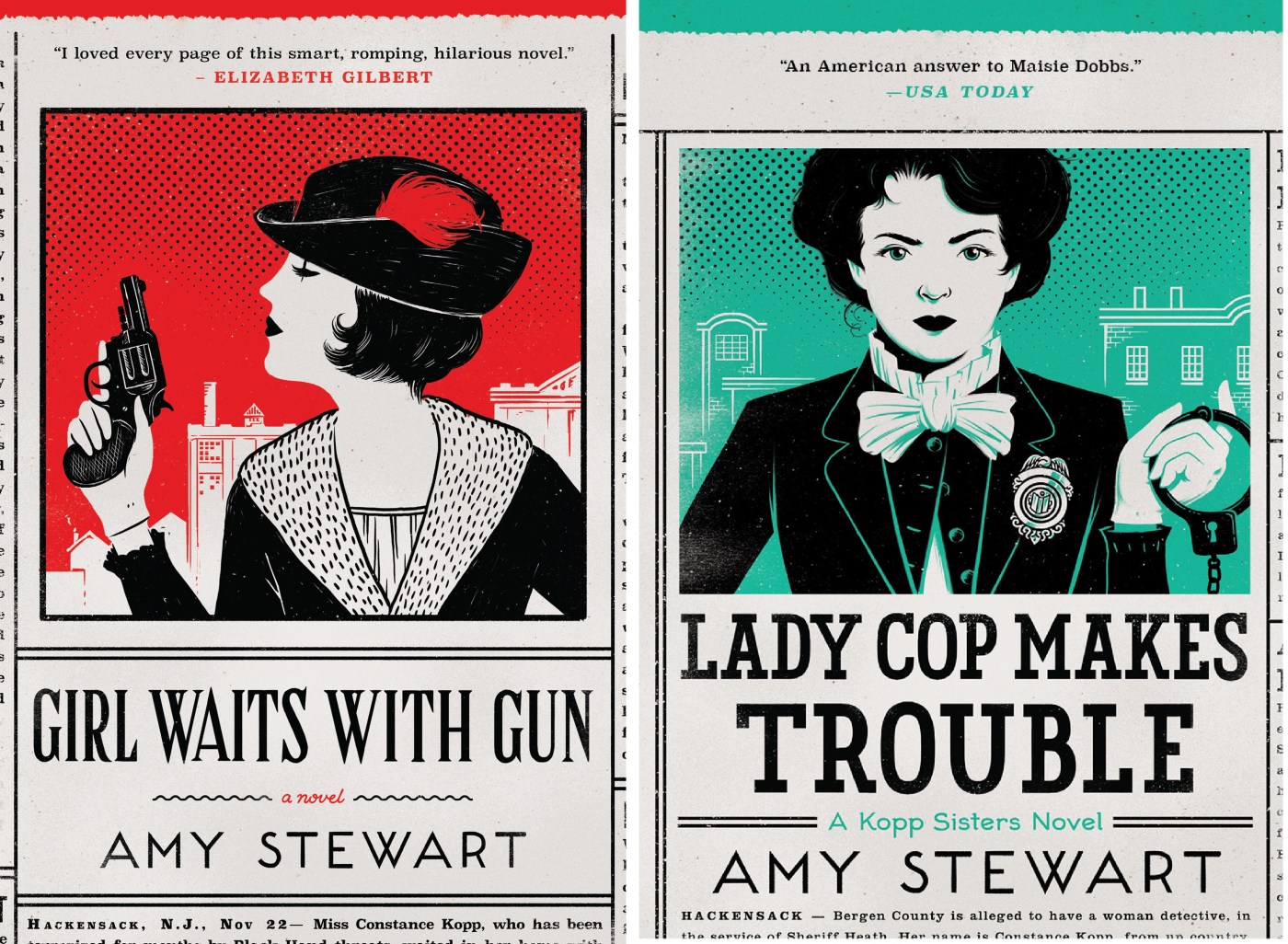
Due to their troubles, the sisters get introduced to the sympathetic and emphatically duty bound town sheriff who offers them protection. He takes it upon himself to teach Constance how to use a gun, encourages her to press charges against the culprit-in-chief and helps her doggedly pursue him. The first book titled “Girl waits with Gun” is amazingly written and although the situation for the ladies is difficult, there is plenty of humor and Constance is a super cool woman. In pursuing this rich thug, she discovers her knack for detective work and is really good at it too. She takes lead, makes smarter choices and thinks to look where others don’t and succeeds (Yes!!). A well-built woman, she is not afraid to chase after wrongdoers and catch them – all while wearing a corset, long flowing skirts and uncomfortable shoes :). All this work gets her the job of a ‘deputy sheriff’.

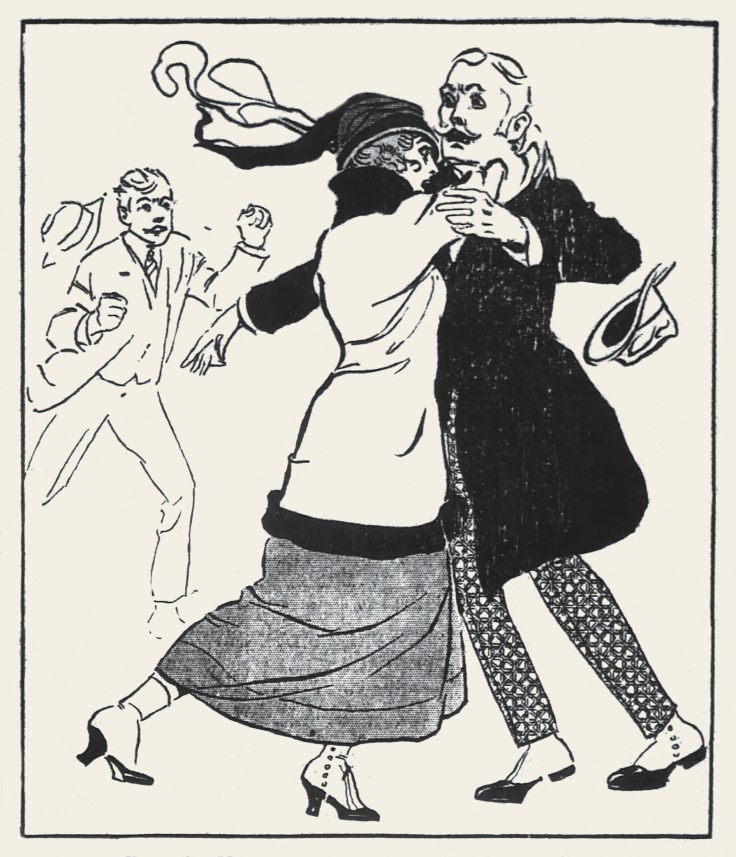
In the equally colorful and adventurous sequel “Lady cop makes trouble”, as the sheriff works to get her a deputy badge, Constance works as the jail matron. She is very good at that job too but yearns to get her badge soon and officially do detective work. Back in 1915, she was one of the few women working in law enforcement that were actually paid a salary, allowing her to support her family. It would be no easy task for the sheriff to convince the county officials (referred to as freeholders in New Jersey) that a woman deserves to serve in the police department much less as the deputy to a sheriff, a job considered totally inappropriate for a woman (although many men in the department were less than capable and did not have much training). The 37year old Constance often gets referred to as the ‘girl’ in the press. Even when she catches a culprit after a chase and a fierce fight (see image below), some of the papers of the day take it upon themselves to make her actions read lady like. Take for instance the headline “Girl deputy sheriff “pinches” a minister!”. The report goes further to completely change what really occurs and publishes that “she stepped up to a husky well-dressed man in front of Borough Hall and tapped him on the shoulder”. Constance takes these in her stride and continues being a totally bodacious cop!

lady-cop-drawing-of-constance-fighting-von-matthesius

Last year, I was looking at NPR’s book recommendations and chanced upon Amy Stewart’s “Girl waits with Gun”. Amy Stewart’s descriptions of Brooklyn and the suburban areas in the early 20th century and the factual notes of Constance’s life and times, are all a treat for the reader. Both the novels she has penned in this series are absolutely delightful. Constance Kopp is one cop you want to read about 🙂

For more fun details:

Amy stewart’s website on the characters featured in the books- http://www.amystewart.com/characters/

Blog at WordPress.com.

Up ↑